




If you’ve been researching hosting recently, you’ve probably seen providers advertise:
“NVMe Storage”
“SSD Hosting”
“Ultra-Fast NVMe Servers”
But what’s the real difference?
Is NVMe actually faster — or is it just marketing?
Let’s break it down properly.
What Is SSD Hosting?
SSD stands for Solid State Drive.
Unlike traditional HDDs (hard drives), SSDs:
Have no moving parts
Deliver much faster read/write speeds
Provide lower latency
Improve overall server responsiveness
For years, SSD hosting was considered premium.
Compared to HDD, SSD is dramatically faster — especially for database-driven websites like WordPress.
What Is NVMe?
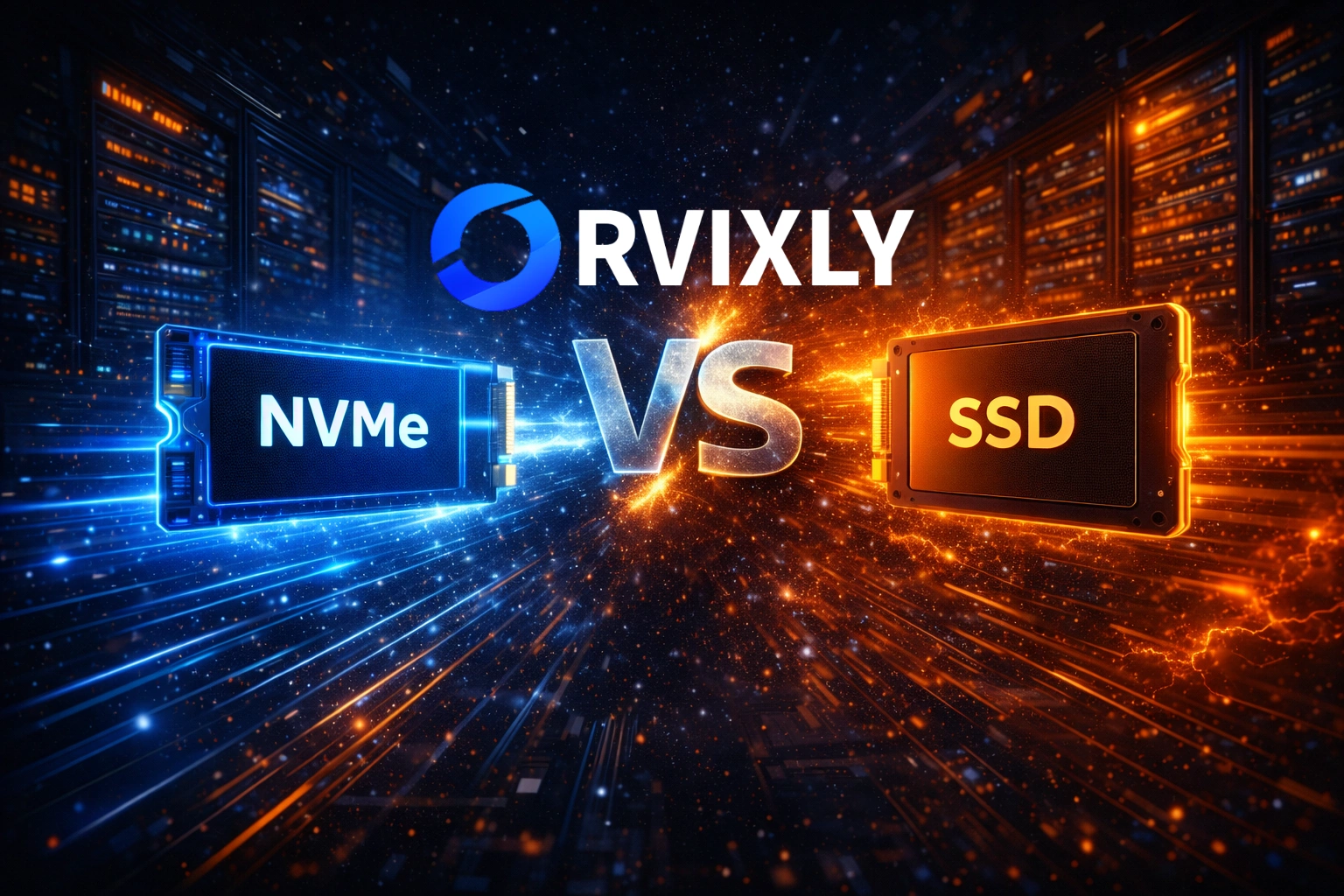
NVMe (Non-Volatile Memory Express) is not just a drive type — it’s a communication protocol.
Traditional SSDs typically use the SATA interface.
NVMe drives connect directly via PCIe lanes, allowing:
Significantly higher throughput
Lower latency
Higher IOPS (Input/Output Operations Per Second)
Better parallel processing
In simple terms:
NVMe removes the bottleneck that SATA SSDs have.
Real Performance Differences
Here’s where it matters.
SATA SSD Typical Performance:
~500–600 MB/s read speed
Higher latency
Limited queue depth
NVMe Typical Performance:
3,000–7,000+ MB/s read speed
Ultra-low latency
Massive parallel request handling
That’s not a small difference.
That’s multiple times faster.
Why It Matters for Hosting
Websites constantly perform:
Database queries
File reads
Cache retrieval
Log writes
On high-traffic or dynamic websites, storage speed directly affects:
Time To First Byte (TTFB)
Page load speed
Backend responsiveness
WooCommerce checkout speed
NVMe significantly improves:
Database-heavy applications
Large WordPress sites
High-concurrency environments
Does NVMe Always Make a Huge Difference?
Not always.
If:
The site is very small
Traffic is low
Caching is aggressive
CPU is the bottleneck
Then the difference may be less noticeable.
But under load?
NVMe shines.
Especially when combined with:
Server-level caching
Object caching (Redis)
CDN integration
Modern PHP versions
IOPS & Concurrency: The Hidden Advantage
Many people focus only on MB/s speed.
But hosting performance is more about IOPS and latency.
NVMe handles:
More simultaneous requests
Higher concurrency
Better performance under traffic spikes
This is crucial for:
eCommerce
Membership sites
SaaS platforms
APIs
NVMe + Proper Infrastructure = Real Performance
Storage alone isn’t everything.
True performance requires:
Modern CPU
Sufficient RAM
NVMe storage
Server-level caching
Optimized web server
CDN layer
When these layers work together, websites become extremely fast and stable.
So… Should You Choose NVMe Hosting?
If you care about:
Performance
Scalability
Stability under load
Modern infrastructure
Then yes — NVMe hosting is worth it.
Especially in 2026, where users expect instant page loads.
Final Thoughts
SSD hosting was a huge upgrade over HDD.
NVMe is the next evolution.
For serious websites, the performance difference is real — especially under load and high concurrency.
At Orvixly, infrastructure decisions are made around real-world performance — not marketing buzzwords.
If you’re unsure which hosting environment fits your project, open a ticket and we’ll guide you through the right setup.
Related Posts